• info@tabletennisnorth.ca

Safe Sport

Safe Table Tennis. Stronger Together.

TT NORTH No Comments

Creating a safe, respectful and inclusive sport environment is not the responsibility of one person. It takes athletes, coaches, officials, volunteers, parents, administrators and everyone around the table working together.

At Table Tennis North, Safe Sport is part of how we deliver and grow our sport across the Northwest Territories. Our goal is simple, every participant should be able to enjoy Table Tennis in an environment where they feel safe, welcomed, respected and supported. This commitment reflects Table Tennis North’s broader values of participation, integrity, accessibility, teamwork and community partnership.

Putting Safeguards Into Practice

Safe Sport requires more than having policies written on a website. It means putting safeguards into practice throughout our programs, clubs, competitions, travel and other activities.

Our approach includes several important areas:

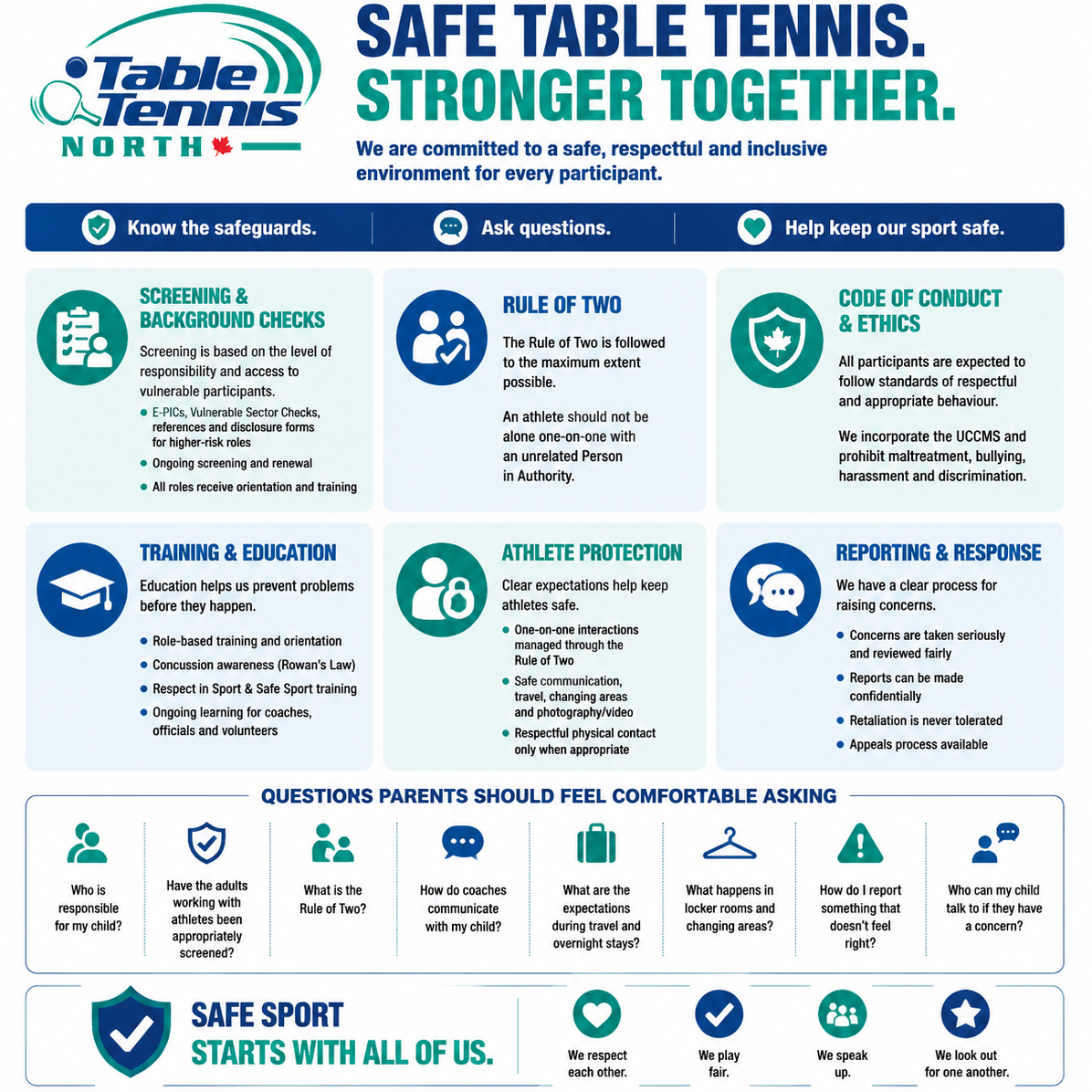
Screening and Background Checks
Screening requirements are based on an individual’s role, level of responsibility and access to vulnerable participants. Depending on the position, this can include Enhanced Police Information Checks, Vulnerable Sector Checks, references and disclosure forms, along with ongoing screening and renewal.

The Rule of Two
We follow the Rule of Two to the maximum extent possible. The principle is designed to ensure interactions with participants, particularly minors, are open, observable and justifiable. Athletes should not be placed in situations where they are alone one-on-one with an unrelated Person in Authority.

Code of Conduct and Ethics
Everyone involved with Table Tennis North is expected to contribute to a respectful environment. Our expectations address appropriate behaviour and prohibit maltreatment, bullying, harassment and discrimination.

Training and Education
Education helps prevent problems before they happen. Coaches, officials, volunteers and others in positions of responsibility may be expected to complete role-appropriate education, including Safe Sport training, Respect in Sport, concussion education and other relevant NCCP training.

Athlete Protection
Safe Sport also means thinking about the everyday situations surrounding sport. Communication with athletes, travel, changing areas, photography and video, physical contact and one-on-one interactions all require clear expectations and appropriate boundaries.

Reporting and Response
Participants need to know that they can speak up when something does not feel right. Concerns should be taken seriously, reviewed fairly and handled as confidentially as possible. Retaliation against someone for raising a concern is not acceptable.

Parents Should Feel Comfortable Asking Questions

Parents and guardians are important partners in Safe Sport.

We want families to ask questions such as: Who is responsible for my child? Have the adults working with athletes been appropriately screened? What is the Rule of Two? How do coaches communicate with athletes? What are the expectations during travel and overnight stays? What happens in locker rooms or changing areas? How do I report a concern? Who can my child speak with if something does not feel right?

Asking these questions is not a challenge to a coach or organization. It is part of creating a healthy sport environment.

Safe Sport Starts With All of Us

Policies, screening and training provide an important foundation, but ultimately the culture of our sport is created by the people participating in it.

We respect each other. We play fair. We speak up. We look out for one another.

Table Tennis has the ability to bring people of different ages, abilities and communities together. As we continue creating opportunities across the Northwest Territories, we also want to make sure the environments surrounding those opportunities are ones in which people feel they belong. Table Tennis North’s programming is built around creating accessible, welcoming and inclusive opportunities throughout the territory.

Safe Table Tennis. Stronger Together.
Safe Sport Starts With All of Us

TT NORTH No Comments

Creating safe, welcoming, and inclusive sport environments is everyone’s responsibility. Whether you’re a coach, official, volunteer, administrator, parent, or athlete, every person involved in sport has a role to play in preventing maltreatment and helping participants thrive. 

The Coaching Association of Canada’s Safe Sport Training provides free online education designed to help everyone involved in sport recognize, address, and prevent maltreatment while promoting healthy physical, psychological, social, and spiritual sport environments. The training aligns with the Universal Code of Conduct to Prevent and Address Maltreatment in Sport (UCCMS). 

The training is designed for a wide range of participants, including:

  • Coaches and individuals with direct athlete contact
  • Officials
  • Sport administrators and decision-makers
  • Volunteers and individuals without direct athlete contact

The self-paced online module takes less than 90 minutes to complete, is available free of charge, works on any device, and can be accessed through The Locker. Once completed, your certification is automatically added to your NCCP transcript. 

Participants will gain knowledge in three key areas:

  • Acknowledgement
  • Understanding that everyone has a responsibility to keep sport safe, how power imbalances can contribute to maltreatment, and the principles of the Universal Code of Conduct.
  • Awareness
  • Learning to recognize different forms of maltreatment, the conditions that allow them to occur, and the warning signs that something may be wrong.
  • Knowing how to respond if maltreatment is suspected and how to contribute to a culture where every participant feels safe, respected, and supported.  

Safe sport is about more than policies. It is about creating environments where everyone feels valued, respected, and able to enjoy the many benefits of sport. Learn more and complete the free Safe Sport Training at SafeSport.coach.ca. 

Canadian Sport Policy 2025–2035: A Shared Vision for Sport in Canada

TT NORTH No Comments

The Canadian Sport Policy 2025–2035 is a national framework designed to guide and inspire everyone involved in sport, from community organizers to high-performance coaches, to create environments that are people-focused, values-driven, and dedicated to enhancing the health and culture of Canada.

At its heart, the Policy emphasizes that sport must always be focused on the good of the participants. It calls on all sectors to work together to ensure that sport in Canada is inclusive, ethical, and rooted in shared values.

The Vision

Working together to enable everyone to grow, excel, and achieve wellbeing through sport.

Core Contexts of Sport

  • Participation – Building motivation, confidence, physical competence, knowledge, and understanding to value and take responsibility for physical activity for life.
  • Performance – Supporting participants to reach their goals and ambitions at progressively higher levels of competition within a values-based, ethical framework.

Desired Outcomes

  1. Canadians are Healthy – Sport contributes to physical, emotional, social, spiritual, and mental wellbeing.
  2. Communities are Strong and Resilient – Sport strengthens culture, identity, economic vitality, and social connections.
  3. Canada is an International Leader – Our nation is recognized for sport excellence, and for the health, happiness, and pride sport inspires.

Shared Values

The Canadian Sport Policy is built on values that shape every aspect of sport in Canada:

  • Fun
  • Inclusion and Accessibility
  • Diversity
  • Healthy and Safe
  • Ambition
  • Fairness and Integrity
  • Responsibility and Accountability
  • Community-Building

Measuring Success

Implementation will be guided by evidence, ongoing evaluation, and clear links between policy goals, outcomes, and objectives. This ensures that actions remain relevant and impactful over time.

The Canadian Sport Policy 2025–2035 is more than a vision document, it is a commitment to ensuring that sport in Canada uplifts individuals, strengthens communities, and inspires the nation.

For more information, visit CSP.sirc.ca

Quick Guide to the UCCMS (Universal Code of Conduct to Prevent and Address Maltreatment in Sport)

TT NORTH No Comments

The UCCMS outlines key expectations and standards for creating safe, respectful, and inclusive sport environments. Here’s a quick breakdown of what’s inside:

Purpose & Scope

    • Establishes a national standard to prevent and address maltreatment in sport.
    • Applies to all participants: athletes, coaches, officials, administrators, volunteers, and others.

    Core Principles

      • Everyone has the right to participate in sport free from abuse, harassment, neglect, and discrimination.
      • Emphasizes integrity, safety, fairness, inclusion, and respect.

      Prohibited Conduct
      The UCCMS defines and prohibits:

        • Psychological Maltreatment – including emotional abuse, bullying, and gaslighting.
        • Physical Maltreatment – any form of physical violence or neglect.
        • Sexual Maltreatment – harassment, abuse, or exploitation of a sexual nature.
        • Neglect – failure to meet basic needs of athletes (e.g., medical, nutrition, emotional).
        • Grooming & Boundary Transgressions – inappropriate relationships or interactions.
        • Discrimination, Harassment & Abuse of Authority – based on race, gender, sexuality, etc.

        Responsibilities & Duty to Report

          • Every sport organization must implement policies aligned with the UCCMS.
          • Participants must report any violations they witness or experience.
          • The Independent Sport Integrity Office (OSIC) manages complaints for national-level sport.

          Sanctions & Accountability

            • Outlines how investigations happen and what sanctions may result.
            • Ensures a fair and transparent process for handling complaints.

            Education & Prevention

              • Encourages training and education as proactive tools.
              • Emphasizes the importance of creating cultures of trust and safety.

              This summary helps sport leaders and participants quickly understand what the UCCMS stands for and why it matters. For the full document, you can read it here: https://sportintegritycommissioner.ca/sites/default/files/2022-06/UCCMS-v6.0-20220531.pdf

              1

              Are you interested in Table Tennis in the Northwest Territories?